


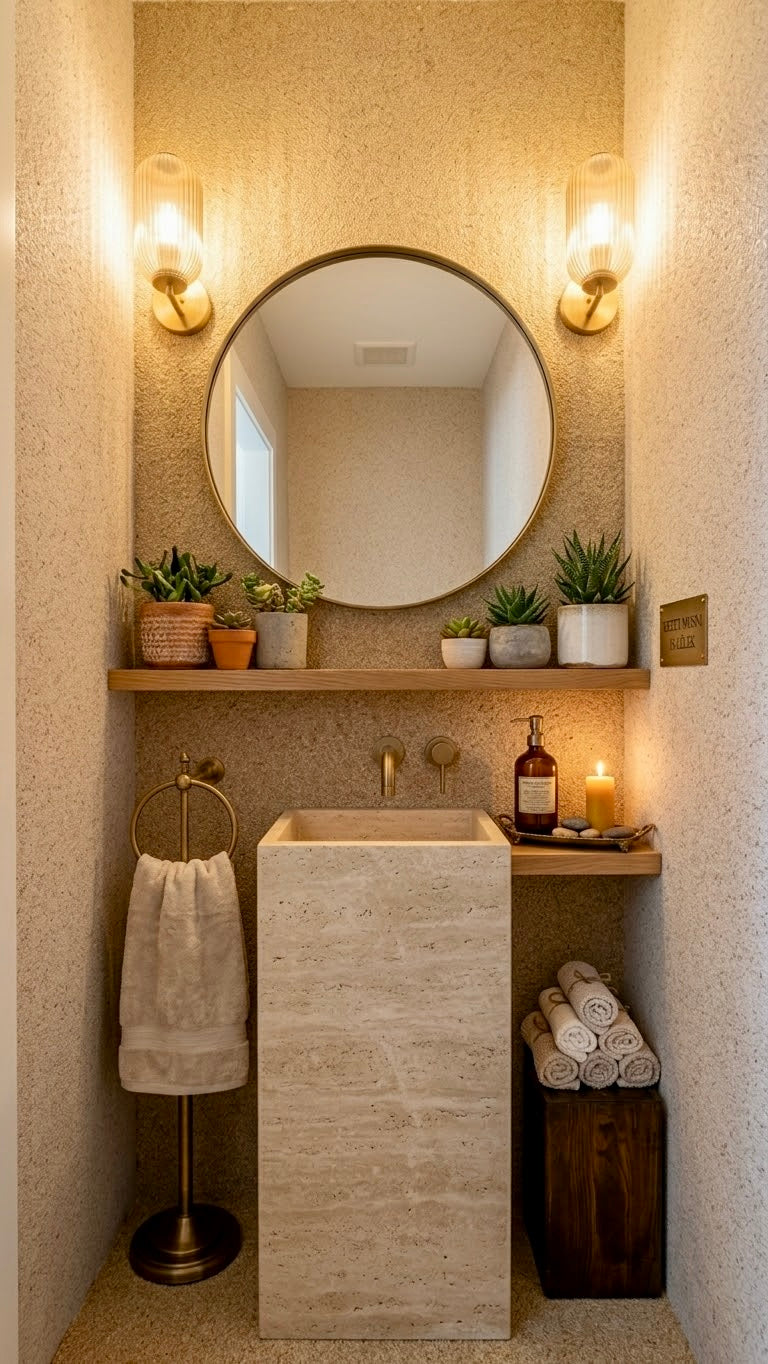
 A seamless, continuous surface with a natural stone look — walls and floor in the same material, without a break.
Bathrooms and showers are among the most beautiful places for stone carpet — and also the least forgiving. There is no room for rushing here: what is a minor flaw on a terrace becomes water damage behind the wall in a bathroom.
In this guide we show you what makes a shower or bathroom seamless and spa-like with stone carpet, and what you need to approach differently than on a terrace: which step is mandatory, what lies beneath the surface, and which mistake causes the most trouble.
Why is it a good choice for bathrooms and showers?
Stone carpet creates a continuous, seamless surface: no tile edges and no grout lines where mold can settle. Walls and floor can flow into each other in the same material without a break — this is what creates the natural, “carved from one piece” spa effect you can see in the photo above. It is solvent-free, so you can use it with confidence even in enclosed, small bathrooms and showers, without unpleasant odors.
The system is officially recommended for indoor wet rooms: toilets, bathrooms, showers and kitchens. It is no coincidence that we list exactly these spaces — but it is precisely this moisture that makes the installation here subject to stricter rules than in a dry hallway.
The rule that is never optional here
With the VIRANIX 1K stone carpet, the PRIMECOAT 2K topcoat is always part of the system — on a terrace or in a hallway too, where it also makes the surface more attractive and easier to clean. In a shower, and on any bathroom surface exposed to permanent water, it matters even more.
The VIRANIX PRIMECOAT 2K topcoat is mandatory in showers and on permanently wet bathroom surfaces — just as it is everywhere else in the 1K system, it is not an optional extra. In its basic state the stone carpet is open-pored, so only the 2K sealing closes it and makes it suitable for daily, permanent contact with water.
We covered the application of PRIMECOAT 2K in detail in an earlier article, the one on applying PRIMECOAT 2K — the mixing ratio, rolling and curing time apply in the shower in exactly the same way.
What lies beneath the surface is decisive
Stone carpet does not hide a poor substrate — this is true on a terrace as well, but in a bathroom the stakes are much higher. A few points that need special attention here:
Around the shower tray
The wall–floor junction and the strip around the drain are the most critical points: this is where water stands or runs permanently.
Corners and junctions
Wall-to-wall and wall-to-floor corners move slightly with changes in temperature and moisture — they need flexible sealing, not a rigid material.
Plasterboard walls
A moisture-sensitive substrate: in the wet zone, it is not worth the risk without a separate waterproofing layer.
In practice this means that in the wet zone of a shower (around the shower tray up to a height of approx. 2 m, and across the entire floor) a separate waterproofing layer is installed before the stone carpet system: a flexible, watertight coating on the wall and floor, reinforced with sealing tape at the corners and around the drain. Only on this stable, watertight base do you apply the TERRALOCK 1K primer, then the stone carpet, then the mandatory PRIMECOAT 2K.
Important: PRIMECOAT 2K seals the surface of the stone carpet; it does not replace the structural waterproofing of the walls and floor. Together they form a durable, safe system — in a shower, neither is enough on its own.
Layer build-up in the shower
Grain size and surface feel
In bathrooms and showers most people choose the fine-grain version: it feels finer to the touch, is more pleasant barefoot, and looks better in detailed areas (corners, plinths, small floor areas). For walls and plinths, this is also the official recommendation: fine grain, 2–4 mm thickness.
| Surface | Thickness | Consumption |
|---|---|---|
| Shower wall, plinth | 2–4 mm | 6–9 kg/m² |
| Bathroom floor, shower floor | 4–6 mm | 9–12 kg/m² |
On top of this comes the TERRALOCK 1K primer (approx. 150 g/m²) and the PRIMECOAT 2K topcoat (approx. 0.30 kg/m², in two coats).
Precise spreading, compacting and the placement of section boundaries follow the same rules as for any stone carpet surface — we show these step by step, with videos, in our installation guide.
Cleaning and everyday use
A surface sealed with PRIMECOAT 2K is much easier to keep clean than an open-pored surface: soap residue and limescale cannot build up in the pores.
Recommended
Damp mopping with a microfiber mop or cloth, if necessary with a neutral (near pH-neutral) cleaner.
Avoid
Strongly acidic or alkaline products, abrasive scouring pads, solvent-based industrial degreasers.
After use, it is worth ventilating or running an extractor fan to remove the humidity — not because the system would otherwise be “delicate”, but because faster drying is always gentler on every bathroom surface: tiles and grout just as much as stone carpet.
Typical bathroom mistakes
Skipping PRIMECOAT 2K “because it looks good without it”
Consequence: the surface remains open-pored, cannot withstand permanent water exposure and can lead to water damage in the long run.
Solution: the 2K sealing is not a step you can skip — it is part of the 1K system, and in a shower above all.
No fall towards the drain
Consequence: standing water and permanent moisture, which is good neither for the stone carpet nor for the layers beneath it.
Solution: the fall must be created before the stone carpet, when the substrate is formed.
Unsealed corners and junctions
Consequence: moisture enters the structure exactly where it is hardest to repair later.
Solution: flexible sealing tape in the corners before the stone carpet layer is applied.
Applied directly on plasterboard, without separate waterproofing
Consequence: the moisture-sensitive substrate can deteriorate over time, which also puts the adhesion of the surface at risk.
Solution: in the wet zone, always a separate waterproofing layer beneath the stone carpet.
Frequently asked questions
Is stone carpet waterproof on its own?+
No — in its basic state it is open-pored. PRIMECOAT 2K seals its surface, but this does not replace the structural waterproofing of the walls and floor in the wet zone.
Which grain size should I choose?+
In bathrooms and showers, fine grain is the typical choice: a finer feel, more pleasant barefoot, and it is also what we recommend for walls and plinths.
When can I shower on the finished surface?+
Both the stone carpet and the PRIMECOAT 2K applied on top of it must be fully cured before they are exposed to permanent water. Our PRIMECOAT 2K article covers the exact timing in detail.

Fine-grain stone carpet for bathrooms
Smooth-feeling, factory pre-mixed stone carpet in a range of colors.
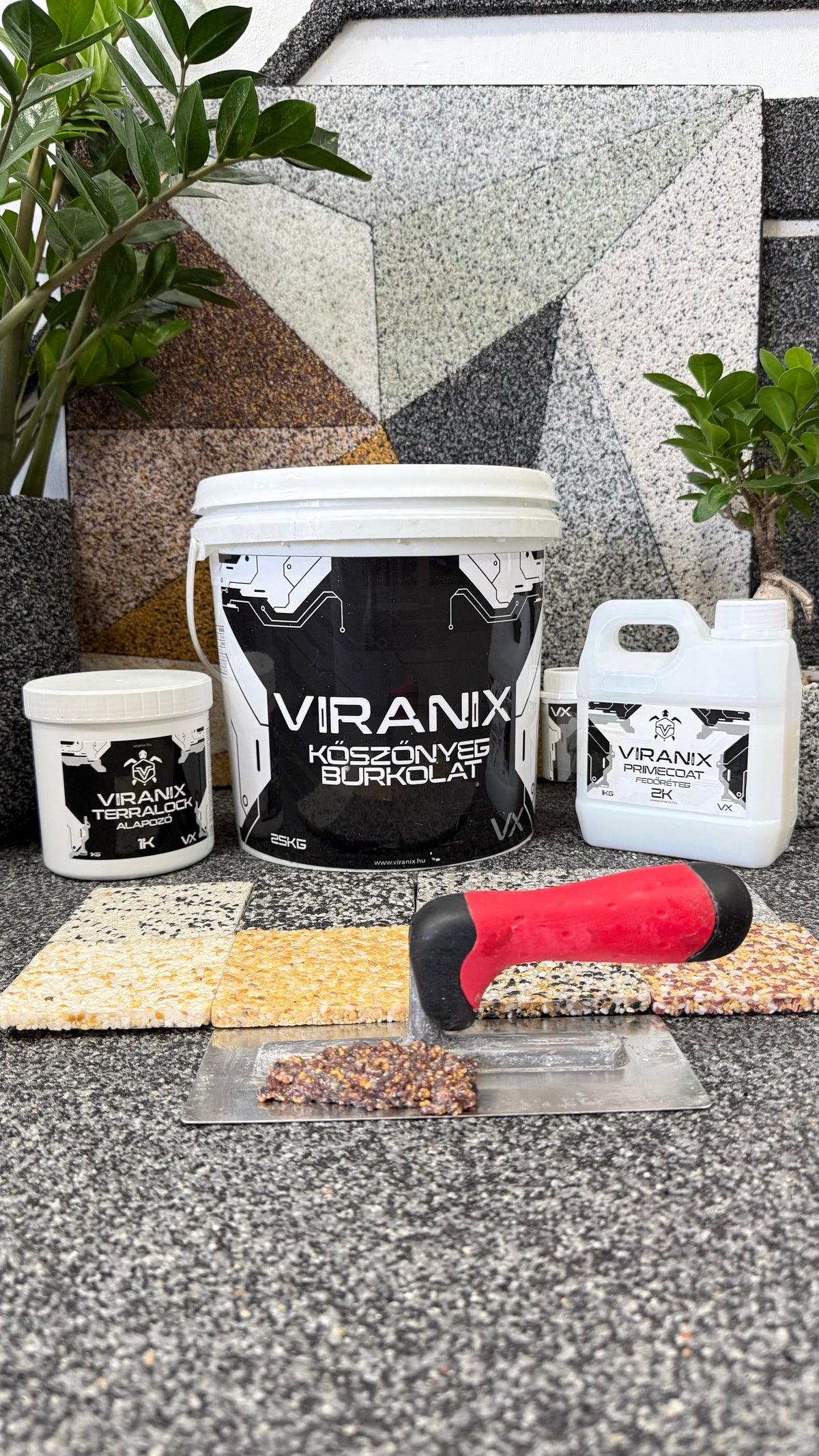
View colorsFurther components of the system: TERRALOCK 1K primer and PRIMECOAT 2K topcoat. Have a question about bathroom installation? Our technical support helps contractors and private customers alike: +36 70 575 5500 (Mon–Sun 9:00–18:00), info@viranix.hu.
Share:
VIRANIX 1K Stone Carpet with PRIMECOAT 2K Topcoat: Step by Step
Installing VIRANIX 1K Stone Carpet Step by Step: Spreading, Compacting and the Most Common Mistakes