

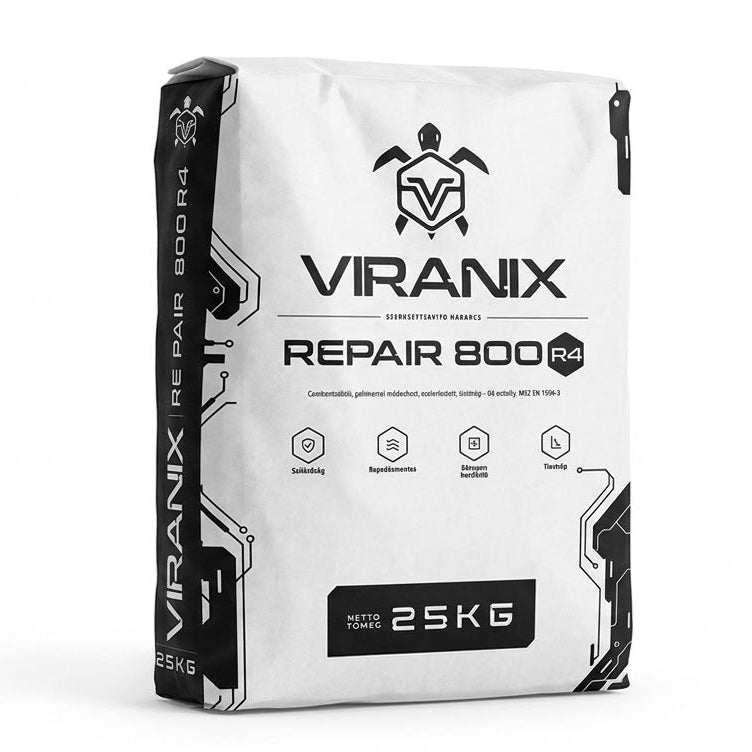

VIRANIX REPAIR 800 R4
Class R4 fiber-reinforced structural repair mortar for reinforced concrete. Thixotropic and can be applied up to 5 cm thick per layer, even on vertical surfaces.
1 m² at 1 cm thickness needs approx. 16 kg. Calculate the exact quantity
Application guide and technical data further down the page
VIRANIX REPAIR 800 R4
Működés
How damaged reinforced concrete is restored
REPAIR 800 R4 is a structural repair mortar in R4, the highest performance class of EN 1504-3. It rebuilds spalled and deteriorated concrete sections in layers of up to 5 cm.
Felhasználás
Where can you use it?
For surface and medium-depth repairs of reinforced concrete structures, indoors and outdoors.
-
Columns, beams, slabs
Restoring spalled and deteriorated reinforced concrete sections.
-
Holes, cracks, breakouts
Filling deep cracks and breakouts.
-
Tie-rod and core holes
Filling tie-rod holes and core cavities.
-
Coving before waterproofing
Forming fillets at wall–floor junctions before waterproofing.
-
Vertical and overhead repairs
Thixotropic consistency: stays in place on walls and ceilings.
-
Industrial floors
Repairing damaged industrial concrete floors.
Kivitelezés
Application step by step
The durability of the repair depends on the preparation: the mortar only bonds properly to a clean, sound, pre-wetted substrate.
-
Prepare the substrate
Clean off formwork oil, paint and dust, and break out loose, weak areas.
-
Clean the reinforcing steel
Remove rust from exposed reinforcing steel and treat it with a corrosion inhibitor.
-
Pre-wet the surface
Pre-wet the substrate before application.
Tipp Do not leave standing water on the surface.
-
Mix the mortar
Pour 4–4.5 liters of clean water into the mixing bucket, add the 25 kg of powder and mix for 2 minutes with a low-speed mixer. Let it rest for 2 minutes, then mix again until homogeneous.
-
Apply with a trowel
Work in layers of max. 5 cm. For thicker repairs, apply the second layer only after the first has hardened, up to a total of max. 7 cm.
Figyelem For significant load-bearing damage or structural problems, an assessment by a structural engineer is required first; the mortar alone does not replace it.
-
Let it cure
Touch-dry in 2–3 hours; full cure takes 28 days.
Calculator
How much mortar do you need?
Enter the area to be repaired and the layer thickness. For a thickness of 1 cm you need approx. 16 kg of mortar per square meter.
Enter the area and the layer thickness.
- Material required
- –
- Recommended quantity
- –
- Estimated price
- –
The calculation is based on average consumption (approx. 16 kg/m² per 1 cm); on uneven substrates actual consumption may differ.
Adatlap
Technical data
- Class, mortar type
- R4 · PCC (EN 1504-3)
- Composition
- Cement-based, polymer-modified, fiber-reinforced
- Compressive strength
- ≥ 60 N/mm²
- Bond strength
- ≥ 2 N/mm²
- Modulus of elasticity
- ≥ 20 GPa
- Chloride content
- ≤ 0.05%
- Capillary water absorption
- ≤ 0.05 kg/m²·h⁰·⁵
- Fire classification
- A1
- Mixing water
- 4–4.5 l / 25 kg
- Material consumption
- approx. 16 kg/m² at 1 cm thickness
- Layer thickness
- max. 5 cm per layer, max. 7 cm in total
- Application temperature
- between +5 and +35 °C
- Drying
- touch-dry in 2–3 hours, full cure in 28 days
- Application tool
- Trowel, steel trowel
- Color, form
- Gray powder
- Storage
- 12 months in unopened bags, in a dry, covered place between +5 and +25 °C
- Packaging
- 25 kg kraft bag
Safe use
Signal word: Danger
- Corrosive
- Irritant
- H315Causes skin irritation.
- H317May cause an allergic skin reaction.
- H318Causes serious eye damage.
- H335May cause respiratory irritation.
- P260Do not breathe dust.
- P280Wear protective gloves/protective clothing/eye protection.
- P302+
P352 IF ON SKIN: Wash with plenty of water. - P304+
P340 IF INHALED: Remove person to fresh air and keep comfortable for breathing. - P305+
P351+ IF IN EYES: Rinse cautiously with water for several minutes. Remove contact lenses, if present and easy to do. Continue rinsing.P338 - P333+
P313 If skin irritation or rash occurs: Get medical advice/attention.
Alkaline when mixed with water. Contains: Portland cement. UFI: 5C00-H0H4-U00H-GY7V. Hungarian Toxicological Information Service (ETTSZ, 0–24 h): +36 80 201 199 (toll-free), +36 1 476 6464.
Protective equipment: alkali-resistant protective gloves (nitrile, neoprene, PVC), tight-fitting safety goggles, FFP2/FFP3 dust mask when dry mixing, long-sleeved work clothing.
Waste: cured mortar is non-hazardous (17 01 01); unused dry powder is hazardous waste (17 09 03*).
GYIK
Frequently asked questions
Can't find the answer? Call us at +36 70 575 5500 or write to info@viranix.hu.
How thick can it be applied?
Max. 5 cm in one layer. For thicker repairs, apply the second layer only after the first has hardened, up to a total of max. 7 cm.
How much mortar do you need?
Approx. 16 kg/m² at 1 cm thickness. For example, a 1 m² repair 2 cm thick needs approx. 32 kg, i.e. 2 bags. You can calculate it precisely with the calculator.
How much water is needed per bag?
4–4.5 liters of clean water per 25 kg of powder.
Can it be applied to vertical walls or ceilings?
Yes. Thanks to its thixotropic consistency it stays in place on vertical and overhead surfaces without sagging.
When does it cure?
It is touch-dry in 2–3 hours; full cure takes 28 days.
At what temperatures can it be applied?
Between +5 and +35 °C.
What does class R4 mean?
The EN 1504-3 standard classifies structural repair mortars by performance. R4 is its highest class.
Can I use it to repair structural damage?
It is intended for surface and medium-depth repairs. For significant load-bearing damage or structural problems, an assessment by a structural engineer is required; the mortar alone does not replace it.
What should be done with rusty reinforcing steel?
Before the repair, the rust must be removed and the reinforcing steel treated with a corrosion inhibitor.
Can it be used outdoors?
Yes, both indoors and outdoors. It is non-combustible, fire class A1.
How long can it be stored?
12 months in unopened bags, in a dry, covered place between +5 and +25 °C.
What protective equipment is needed?
Alkali-resistant protective gloves, tight-fitting safety goggles, an FFP2/FFP3 dust mask when dry mixing and long-sleeved work clothing. It is alkaline when mixed with water.
Rendszer
You may also need
-
For anchoring
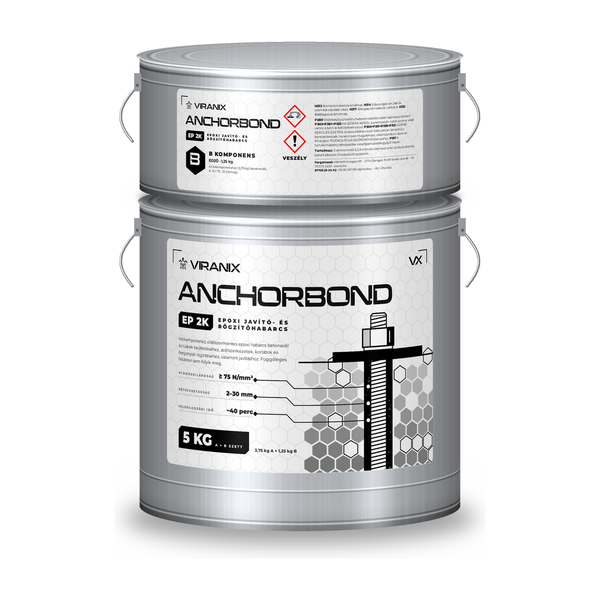
VIRANIX ANCHORBOND EP 2K - Epoxy Repair and Anchoring Mortar
For setting rebar and dowels and for anchoring bolts and steel structures.
20.000 Ft View -
For waterproofing
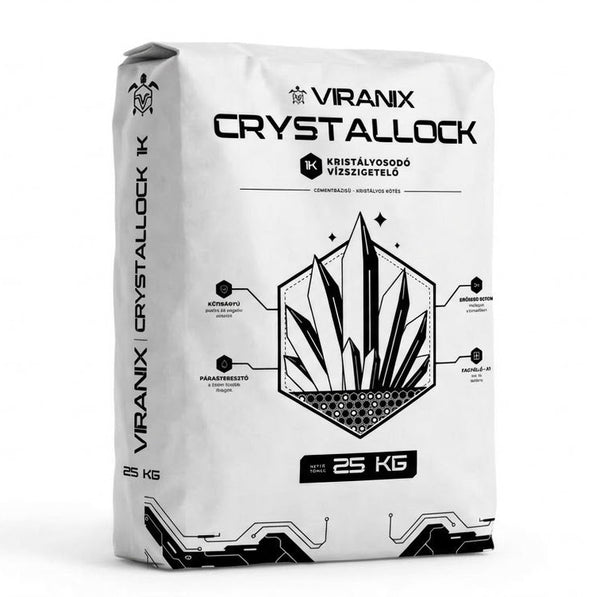
VIRANIX CRYSTALLOCK Crystalline Waterproofing 1K
For waterproofing the concrete after the repair, from both the water side and the inside.
15.000 Ft View
Request a quote for larger repairs
Repairing a column, slab or industrial floor? Tell us the size and depth of the damaged area and we will help you calculate the material requirement.